
Sea-Fire marine systems: identification and service guide
Identify the complete Sea-Fire suppression system—cylinder, agent, protected volume, detection, shutdown and release controls—before authorised service.
Sources checked August 2, 2026
A Sea-Fire cylinder is one part of an installed marine fire-protection system. The suppression agent and charge must match the protected compartment; detection and release must operate correctly; ventilation and engine shutdown may have to coordinate with discharge; alarms and remote controls must remain intelligible to the crew. Servicing only the visible cylinder can leave the system incomplete.
The Safety Pelican services Sea-Fire equipment within its current authorised scope in Sint Maarten. Send a system-level record before attendance or removal so the station can identify the product generation, serviceability, trained-person requirement, parts and onboard test boundary.
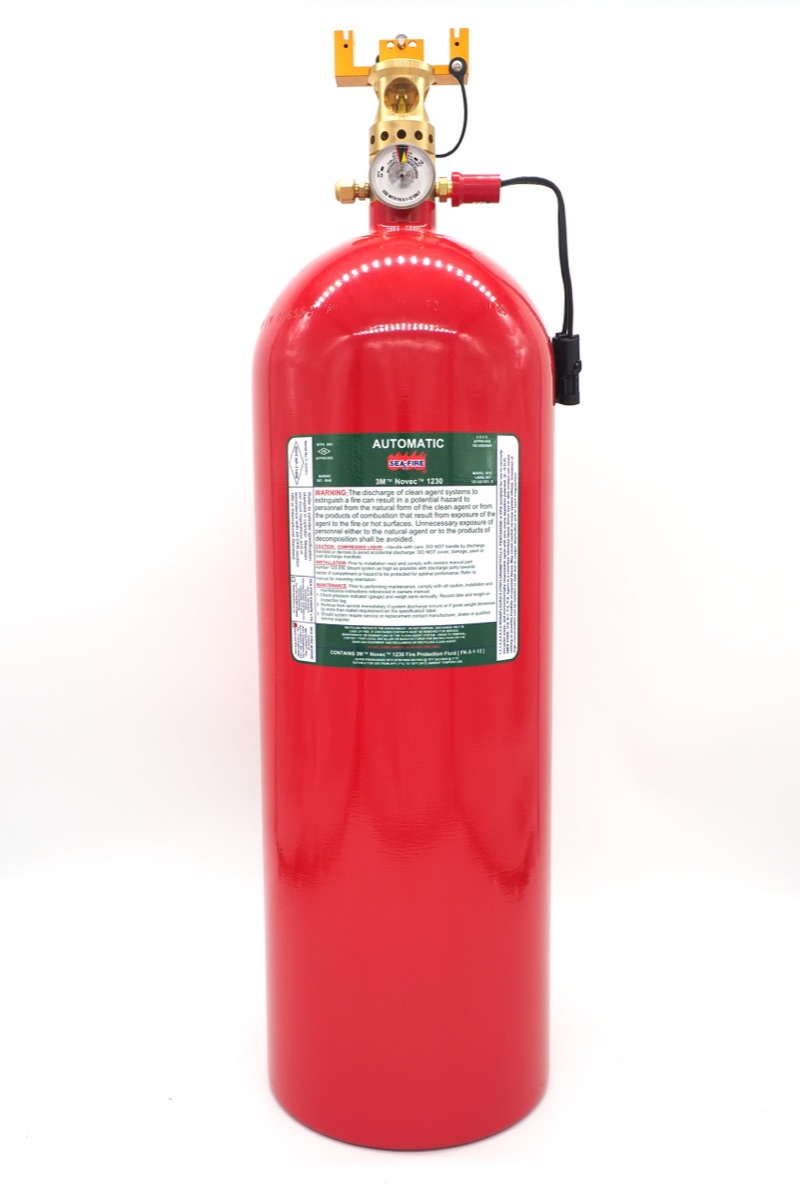
Agent, identity and service record
Protected space and alterations
Detection, shutdown and release
Record the cylinder nameplate and the complete system architecture
Photograph the cylinder and nameplate, model series, serial number, agent, charge or weight, pressure indication, manufacture and service markings. Show mounting orientation, bracket, detector or actuator head, discharge outlets, manual pull, indicator panel, alarms, engine-shutdown interface and the entire protected compartment. Record the compartment dimensions and any alteration since installation.
Do not lift a cylinder by its manifold, loosen a component, operate the manual release or bridge a shutdown input. Sea-Fire manuals warn that accidental discharge can cause serious injury and reserve further pre-engineered-system service to trained competent personnel. Identification should be visual and documentary until the system is made safe under the proper procedure.
- Model, serial, agent and charge
- Pressure and weight information
- Detector and release arrangement
- Alarm and shutdown interfaces
- Protected volume and modifications
Verify that the system still fits the compartment it protects
Pre-engineered suppression relies on the listed model and agent quantity for a defined enclosure volume and installation. Engine replacement, extra tanks, ducting, new lockers, insulation, ventilation changes or enlargement can change the net or gross volume and obstruct discharge. A cylinder with a current label should not be assumed adequate after the machinery space has changed.
Check the manufacturer's manual and the vessel's approved fire plan. Sea-Fire documentation also cautions against combining independent systems as though simultaneous discharge were guaranteed. Any question about capacity, multiple cylinders or a changed compartment needs competent design review, not a service technician's guess at the dock.
- Current compartment volume
- Agent and model suitability
- No obstructed discharge
- Ventilation and opening control
- Design review after modification
Determine whether the cylinder is refillable, replaceable or test-due
Sea-Fire's current N-series instructions distinguish model families whose discharged cylinders are replaced from those that may be refilled when specification, age and condition allow. Filling is limited to authorised locations, replacement parts are manufacturer-controlled and pressure-vessel actions must meet the applicable regional rules. The model and cylinder marking decide the route.
Routine inspection should also cover weight or charge, pressure where provided, corrosion, mounting, discharge components, detector condition, manual release, alarm and shutdown function. Agree which tests can be performed without discharge and which require the vessel, machinery or electrician to be available.
- Refillable or non-refillable series
- Cylinder age and test status
- Authorised filling location
- Manufacturer replacement parts
- Onboard functional-test plan
Prepare a system dossier, not a loose cylinder handover
Provide the vessel flag and use, system manual, installation drawing, last certificate, cylinder photographs, compartment measurements and modification history. Report any discharge, loss of pressure, broken seal, corrosion, alarm fault, shutdown issue or work on engines and ventilation. State the survey and sailing deadline and whether onboard attendance is possible.
At completion, reconcile cylinder and system identity, review weight or pressure results and confirm every isolated circuit, alarm, pull and shutdown connection has been restored. Update the fire-equipment register and crew instructions. The handover is complete only when the system is back in its ready configuration, not when the cylinder returns to the vessel.
- Manual and installation drawing
- Compartment and modification record
- Cylinder and control photographs
- Fault or discharge history
- Restoration and onboard test confirmation
Official sources
Manufacturer and authority references for this guide. Check the current requirements for your equipment and vessel.
- Sea-Fire NFG and NFD fire suppression system manual
Sea-Fire Marine
- Sea-Fire NMG and NMD installation and owner manual
Sea-Fire Marine
- Engine Shutdown Restart System manual
Sea-Fire Marine