
Buckeye fire extinguishers: selection and service guide
Identify the exact Buckeye extinguisher, agent, rating, approval and marine bracket before service or replacement planning.
Sources checked August 2, 2026
Buckeye manufactures several portable-extinguisher families, including dry chemical, carbon dioxide, clean-agent, offshore, wheeled, high-flow and specialist products. The familiar red cylinder does not tell you which fuel class it is rated for, how much agent it carries, whether it has a marine approval or which maintenance instructions apply.
The Safety Pelican services Buckeye equipment within its current authorised scope in Sint Maarten. Sales are handled through The Marine Store by SM Caribbean, while service intake begins with the physical unit, its location and the hazard it is meant to protect.
Read the nameplate, rating and cylinder markings together
Photograph the complete extinguisher, nameplate, model and serial, extinguishing agent, rated capacity, fire rating, approval marks, operating-temperature range, manufacture or test markings and service tag. Add the hose, nozzle, gauge, safety pin and bracket. For a wheeled unit, include the agent cylinder, expellant cylinder, regulator, hose and running gear.
Record the vessel or premises location and the hazard protected. A Buckeye ABC dry-chemical unit, carbon-dioxide extinguisher, Halotron clean-agent unit and offshore model require different inspection points and create different discharge consequences. Never substitute one because the cylinder dimensions happen to fit the existing bracket.
- Model, serial and agent
- Capacity and fire rating
- Approval and temperature range
- Cylinder and test markings
- Hose, nozzle and correct bracket
Marine approval and corrosion-resistant construction are specific features
Buckeye's Offshore line is published with corrosion-protection features, UV-resistant labels and USCG approval when used with the noted marine bracket. That does not make every Buckeye extinguisher an offshore model or every replacement bracket acceptable. Verify the exact product data and delivered mounting hardware against the vessel requirement.
Salt and humidity still demand close inspection. Check the cylinder base beneath protective rings, the bracket contact points, hose couplings, gauge guard and concealed side facing the bulkhead. Surface paint can hide base corrosion, and an extinguisher that cannot be removed promptly from a corroded bracket is not operationally ready.
- Exact Offshore product identity
- Specified marine bracket
- Base and hidden-surface corrosion
- UV and label condition
- Immediate removal from mounting
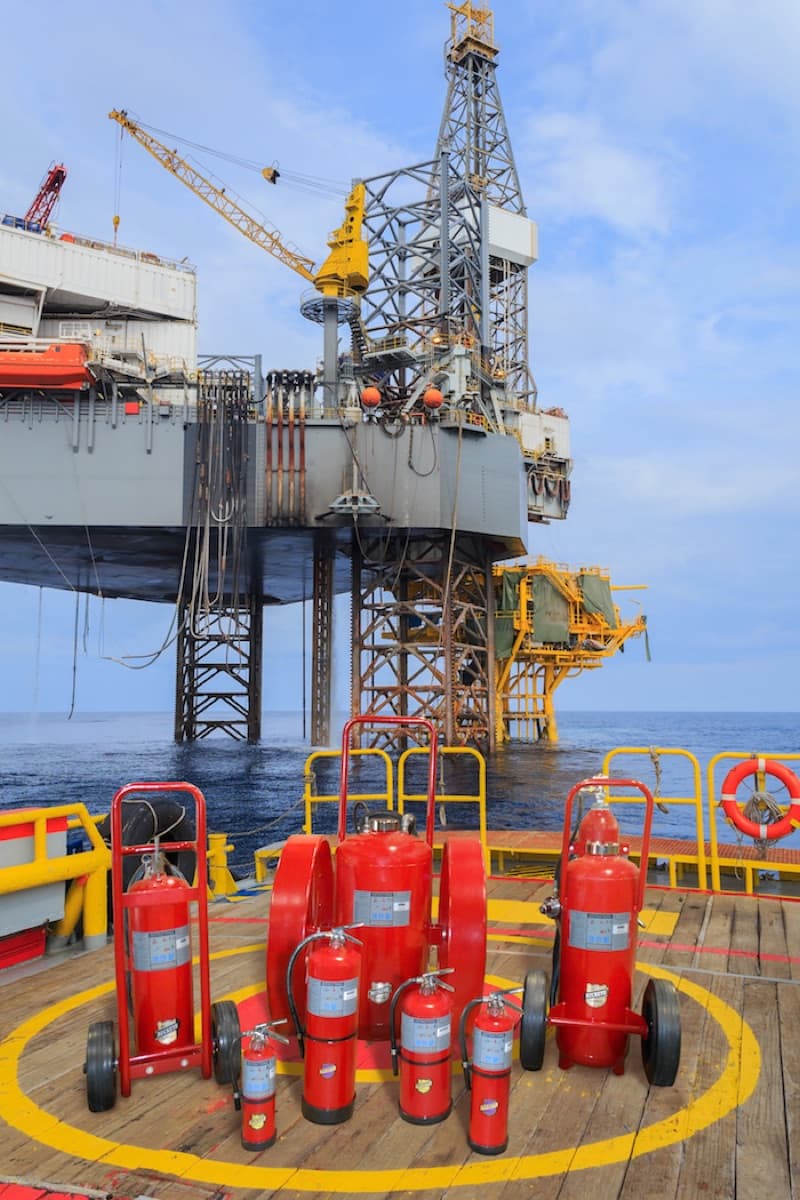
Separate routine inspection from competent maintenance and testing
A visual inspection confirms presence, access, apparent fullness or pressure, pin and seal, physical condition, hose or nozzle and current dates. Buckeye notes that temperature can move a stored-pressure gauge within the green operating zone, so gauge interpretation must consider the unit's rated range and actual condition rather than assuming every off-centre needle proves a leak.
Maintenance is the thorough examination that can lead to repair, recharge or hydrostatic testing under the applicable standard and manufacturer instruction. After discharge—even a brief one—the unit needs competent service. Do not test-fire, mix agents, replace a gauge casually or top up a cylinder without the proper recovery, fill and test process.
- Access, pin, seal and condition
- Gauge read in rated temperature context
- Correct fullness or weight check
- Maintenance after any discharge
- Hydrostatic test when due or indicated
Connect the extinguisher to its application at handover
Send the label and cylinder photographs, location, hazard, vessel or premises use, previous service information and any authority requirement. Report loss of pressure, corrosion, discharge, missing seal, blocked hose, damaged bracket or exposure to heat. If asking for a replacement, provide the required rating and approval—not only the old cylinder's diameter.
On return, verify agent, rating, serial, service status and mounting. Put the unit back in its assigned location with signage and access restored, then update the register. The extinguisher should remain part of a broader fire plan that includes detection, escape, training and any fixed suppression; a larger cylinder is not a substitute for that system.
- Location and hazard
- Nameplate photographs
- Condition and discharge history
- Required approval and rating
- Register and mounting check
Official sources
Manufacturer and authority references for this guide. Check the current requirements for your equipment and vessel.
- Portable fire extinguishers
Buckeye Fire Equipment
- Offshore portable extinguishers
Buckeye Fire Equipment
- Frequently asked questions
Buckeye Fire Equipment